

A donkey, a city gate and a road covered with garments can tell the whole story of Palm Sunday. From Giotto’s fresco to Van Dyck’s canvas, these ten historical works show how painters used different settings, gestures and scales to depict the same arrival. Each entry links to the corresponding reproduction.
In this guide
- Giotto — Entry into Jerusalem
- Duccio di Buoninsegna — Entry into Jerusalem
- Pietro Lorenzetti — Entry of Christ into Jerusalem
- Jan van Scorel — Entry of Christ into Jerusalem, Van Lokhorst Triptych
- Hans Holbein the Elder — Entry into Jerusalem, Dominican Altarpiece
- Anthony van Dyck — Entry of Christ into Jerusalem
- Philippe de Champaigne — Entry of Christ into Jerusalem
- Jorge Afonso — Entry of Jesus into Jerusalem
- William Blake — Entry of Christ into Jerusalem
- Jean-Léon Gérôme — Entry of Christ into Jerusalem
The Gospel story behind Palm Sunday
In Matthew 21:1–11, people spread cloaks and cut branches along the road. John 12:12–19 identifies the branches as palms and recounts the crowd’s acclamation. The donkey recalls the humble king of Zechariah 9:9. In paintings, look for the rider, the gestures of welcome and the part of the city the artist has chosen to show. These clues often identify the moment before you read a caption.
1. Giotto — Entry into Jerusalem

In this Scrovegni Chapel fresco, the procession moves toward the gateway while people spread garments below. The figures in the trees redirect the eye upward and make the welcome feel spontaneous. The gate and the figures on the road tell the story in one clear sweep.
2. Duccio di Buoninsegna — Entry into Jerusalem

Duccio portrays the episode in the narrative cycle of the Maestà for Siena Cathedral. Follow the slope from the apostles toward the people gathered near the gate. The setting gives the procession a direction and makes the city feel like an active part of the story.
3. Pietro Lorenzetti — Entry of Christ into Jerusalem

This version brings the episode into a fresco cycle. Look at where the crowd and the city begin to overlap. The architecture marks the place Christ is approaching, while the figures waiting ahead make the entry a communal event.
4. Jan van Scorel — Entry of Christ into Jerusalem, Van Lokhorst Triptych

The Utrecht triptych places the entry at the center of a larger devotional object. Wings and central panel were made to be read together. This setting gives the biblical crowd a different frame from the one it has in the continuous wall paintings of Giotto.
5. Hans Holbein the Elder — Entry into Jerusalem, Dominican Altarpiece

This panel belonged to the Dominican altarpiece in Frankfurt. Look first for the gestures closest to the donkey, then follow the reactions of the rest of the crowd. The individual figures turn a familiar scene into a series of small encounters.
6. Anthony van Dyck — Entry of Christ into Jerusalem

Van Dyck gives the near figures much of the canvas and lets faces, hands and palms press toward the viewer. The composition makes the welcome feel immediate. The work is in the Indianapolis Museum of Art at Newfields.
7. Philippe de Champaigne — Entry of Christ into Jerusalem

Trace the movement from the crowd toward Christ and then look back at the gestures of welcome. This painting makes a useful comparison with Van Dyck: read each at the scale of the central action first, then notice what the surrounding figures contribute.
8. Jorge Afonso — Entry of Jesus into Jerusalem
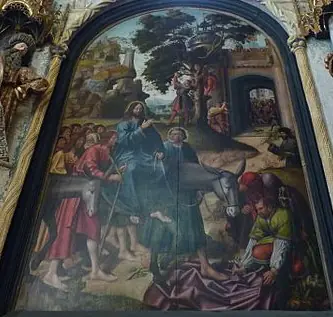
This Portuguese example gives the episode another setting in the history of European altarpiece painting. Look for the details that identify the story before reading the title, especially the humble mount and the public character of the welcome.
9. William Blake — Entry of Christ into Jerusalem

Blake brings his own figure style to the biblical narrative. Compare the movement of the people around Christ with the ordered progress of Duccio’s procession. The contrast shows how much of the story can be carried by posture and gesture.
10. Jean-Léon Gérôme — Entry of Christ into Jerusalem

Gérôme’s interpretation is a later counterpart to the medieval scenes. Look at the relationship between the setting and the procession, then compare it with Giotto’s gate. The contrast helps distinguish a place evoked through setting from a place indicated economically within a continuous fresco cycle.
How to compare different versions
In Giotto and Duccio, the path from the disciples to the gate helps you follow the episode. In a triptych such as Van Scorel’s, the side panels affect how you view the center. Van Dyck puts the near figures and their reactions much closer to you. Compare the same detail, such as an outstretched hand, in all three formats to see what changes with distance and scale.
Explore the companion guide
See 10 modern Palm Sunday art prints →
Continue through Holy Week with our guide to Last Supper paintings.